Where leaders look, what the field sees.
Stress-Testing Jewish Leadership Vision Against Collective Strategic Intelligence from More Than 250 Game Players.
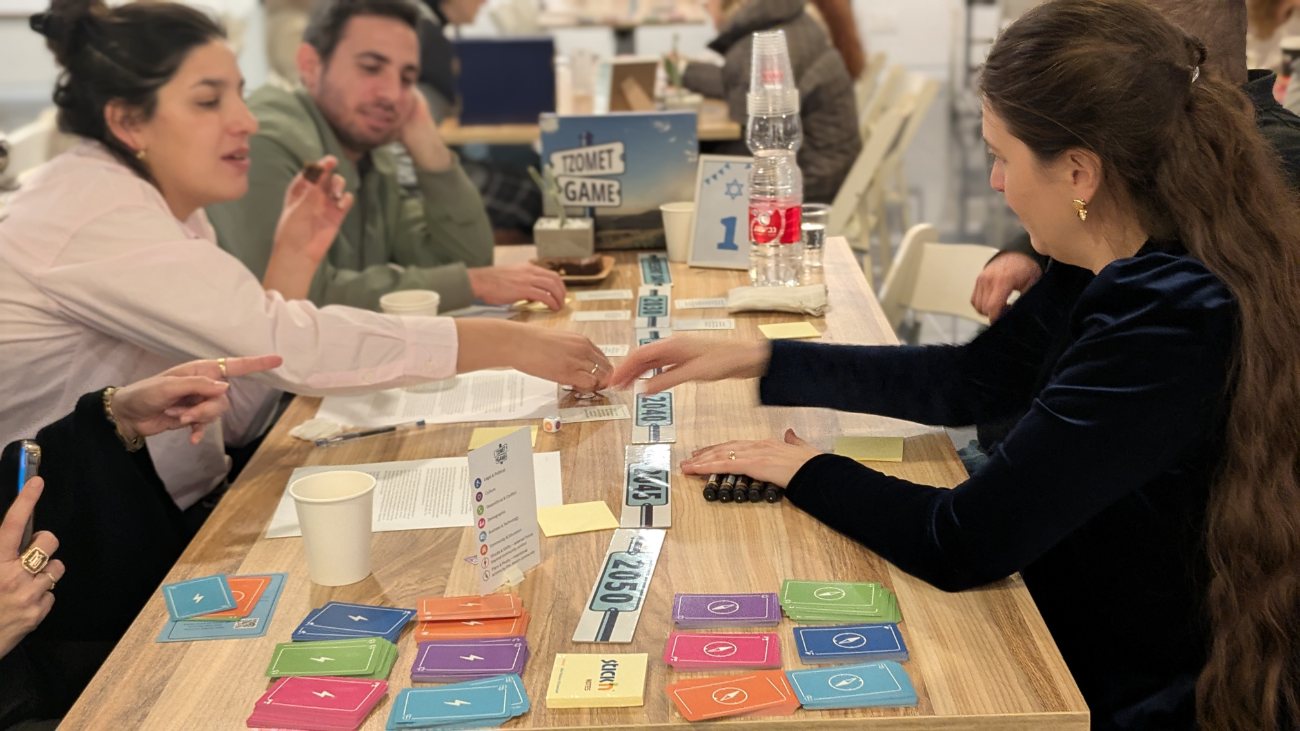
Two ways of imagining the Jewish future.
This report compares the strategic vision articulated by fifteen prominent American Jewish leaders in major conference addresses between May 2025 and March 2026 against the collective strategic intelligence generated by more than 250 Jewish professionals, philanthropists, and emerging leaders who played the Tzomet Game across five forums.
The goal is to illuminate potential gaps in the priorities of the American Jewish community, and to demonstrate the value of using large datasets and many voices to inform communal decisions. The leadership corpus offers a public, institutional articulation of where the community is heading. The game corpus offers something different: insights that are diverse, crowd-sourced, and freer from institutional constraints. Read together, the two surface where the community's collective imagination is already running ahead of, or alongside, the public conversation — and they suggest a way of building shared communal knowledge that helps us better understand the steps and priorities needed to advance the Jewish community toward a better future, and to make sure our resources are invested accordingly.
The Tzomet Game is a structured, scenario-based strategic exercise in which teams of Jewish professionals build timelines from 2025 to 2050 leading to one of four pre-written 2050 scenarios about American Jewish life — two positive (Trending Jews Influence America, The American Jewish Golden Age) and two negative (Secular Collapse, Religious Revival; The Digital Ghetto and the IRL Kibbutz), all authored by Dara Horn.
The fifteen leadership pieces were selected to consist exclusively of major conference addresses and keynote speeches — not op-eds. The choice is methodological: speeches at major Jewish conferences (ADL's Never Is Now, AJC Global Forum, JFNA General Assembly, the Z3 Conference, the JFN Annual Conference, the World Jewish Congress's Jerusalem Post keynote) represent public, on-the-record articulations by senior leaders of institutional priorities. The selected speeches lay out priorities for the Jewish community and articulate a vision for the Jewish future. These fifteen are not a representative or exhaustive sample of Jewish leaders or Jewish gatherings; they are a purposive selection of publicly available addresses, each of which explicitly took up the priorities and future of the American Jewish community. The game data was collected in forums hosted by major Jewish communal organizations and foundations, with a diverse group of Jewish leaders, professionals, philanthropists, and emerging leaders. The dataset consists of 1,903 discrete timeline snapshots from seventy sessions.
This is an interpretive comparison, not a controlled experiment. The speakers were not interviewed on a fixed set of questions, and had they been asked directly about demography, technology, or geography, many would likely have had a great deal to say. The claim here is narrower and more specific: if these public addresses are read as the field's stated direction, that direction leaves out a number of topics that are demonstrably on the minds of the professionals these same leaders convene.
Six gaps emerge from the side-by-side reading
Demographic strategy is missing from leadership discourse
Zero of fifteen speeches make demographic strategy central. The data, by contrast, surfaces conversion as the single most-frequent cross-scenario pathway event (twenty of thirty-five positive-scenario sessions), birthrate and family policy (thirteen sessions), and geographic redistribution (ten sessions). Where leaders treat Jewish demography as a fixed background, players treat it as a variable the community can shape.
AI is framed defensively in speeches, productively in the data
Where the speeches address AI, they treat it almost entirely as a threat: deepfakes, disinformation, and antisemitism amplification. The data, by contrast, surfaces AI-powered Hebrew literacy, AI tutors for adult Jewish learning, Holocaust survivor holograms, Jewish-founded language models, and AI-driven Jewish K-12 schools. AI is the single largest topic in the game data and one of the least-surfaced in the speeches.
Civic and political pipelines are surfaced in the game data but not in the public addresses
Seventeen of thirty-five positive-scenario sessions name some version of Jewish candidates running for office, a Jewish civic leadership accelerator, or a Jewish elected official changing policy. The leadership corpus engages with this only through the language of Jewish leaders also serving as civic leaders in their cities, not as a deliberate pipeline strategy to place Jewish candidates on ballots.
Geographic redistribution is a major theme in the data and a silence in the speeches
Migration to Southern and Sun Belt cities and the formation of Jewish enclaves in mid-size markets appears in nine sessions for the Golden Age scenario alone. No speech engages with where American Jews will live in 2050.
Israel is mostly framed in the speeches as a country requiring defense; in the data, as an exporter, source, and partner
Players surface Israeli desalination democratizing water across a peaceful Middle East, Israeli-led innovation hubs forming in new American cities, Israelis migrating to the United States, and an Israel-led Gaza Reconstruction Corps deploying green architecture. The speeches treat Israel almost entirely as a recipient of diaspora support and as a country whose security must be protected.
The leadership corpus over-indexes on the institutions it represents
Community-and-education themes are central in 10 of 15 speeches (67%), compared to only 25% of player snapshots. Leaders weigh their own institutional turf roughly 2.5 times more heavily than the field does when imagining the future. This is not unreasonable, and it should not be read as a failure: leaders naturally speak from where they sit, and their organizations are the levers they actually control. But it does mean the speech corpus systematically under-represents the broader imaginative range the field itself is generating in the game: surfacing AI, demographics, geopolitics, and cultural production at levels the leadership discourse does not match.
Where leaders and players align — on day schools and Jewish education, on antisemitism as a real pressure, on the centrality of Israel-Diaspora engagement, on inward philanthropic redirection, on the need for institutional reform — the alignment is genuine and worth building on. But the gaps are larger than the alignments, and they suggest that the field already contains the imaginative support for agendas leaders have not yet publicly articulated or tapped into.
The analysis proceeds in eight parts. Each can be read on its own, or in sequence — click any section to jump to it.
01 MethodologyHow the two bodies of material were assembled and compared. → 02 What the Leaders Get RightThe priorities where the speeches and the game data already agree. → 03 The Gap AnalysisThe topics the field surfaces most that the speeches surface least. → 3.9 Framing MisalignmentsTopics both address, but as different strategic objects. → 04 Pathways to Positive FuturesThe events the field maps as roads to the two positive 2050 scenarios. → 05 Threats and WarningsThe mechanisms the field maps toward the two negative 2050 scenarios. → 06 The Israel-Diaspora LensThe single most-discussed topic in both corpora, examined on its own. → 07 Discussion and ImplicationsWhy the two corpora diverge, and what follows for communal strategy. →How the analysis was built.
1.1 The Leadership Corpus
Fifteen speeches and conference addresses delivered between May 2025 and March 2026 were analyzed. The corpus consists exclusively of major addresses at significant Jewish conferences — settings where senior leaders explicitly articulate the priorities of their organizations and the future of the community. Op-eds and commentary writing were excluded by design: the universe of available op-eds is large and selecting any particular set risks bias, whereas conference keynotes represent a more bounded, self-selecting corpus.
It bears emphasizing that this corpus is a selected sample, not a survey. The fifteen pieces are not a representative cross-section of American Jewish leadership, nor do they cover every major gathering; many significant leaders and convenings are not included, and a wider net would add more voices and likely more themes. The speeches were chosen on three criteria: they were publicly available, they were delivered at major convenings, and each addressed priorities for the future of the American Jewish community.
The corpus represents leaders from advocacy (ADL, AJC, World Jewish Congress), the Federation system (JFNA), the JCC movement, strategic philanthropy (JFN), and prominent independent voices. Each piece was coded against the six Tzomet themes on a three-point scale — absent, mentioned, or central. Each piece counts as a single voice regardless of length. No individual leader is named in the analysis.
1.2 The Game Dataset
The dataset contains 1,903 snapshots from 70 sessions across 5 game events. With an average of approximately five players per session, the total participant count is more than 250 (some played multiple sessions). Each snapshot is a single event placed on a 2025-to-2050 timeline leading to one of the four 2050 scenarios. Snapshots are tagged with year placement, scenario, type (community agency or external force), and one or more themes. Data was recorded by players through a designated app developed by the Tzomet Games team.
A note on method. Strategic foresight in the Jewish community has traditionally drawn on a small number of expert voices — a commissioned study, a blue-ribbon panel, a handful of keynote thinkers. The Tzomet Game takes a different approach: rather than a few deeply considered opinions, it attempts to capture many independent ones. The 1,903 snapshots in this dataset represent hundreds of distinct judgments placed by more than 250 people across seventy sessions, and the patterns reported here emerge from what recurs across that breadth rather than from any single voice. We see real value in building shared communal knowledge this way, assembling large, structured sets of distributed judgment, and using new technological tools, including AI, to gather, structure, and learn from them at a scale that was previously impractical. This report is an early experiment in that direction.
1.3 Analytical Framework
The analysis proceeds in six stages: alignment between corpora; three forms of gap (topical silences, under-emphasis, framing misalignments); pathway events in positive scenarios; threats in negative scenarios; the Israel-Diaspora lens; and implications.
Four caveats matter throughout.
First, this is an interpretive comparison rather than a controlled experiment. We did not interview the speakers on a fixed topic list, hold the prompt constant across the two corpora, or ask leaders to imagine American Jewry in 2050 the way players were asked to. Had we done so, the speakers — many of whom lead the very organizations these professionals work in — might well have surfaced the same themes the game data surfaces. The comparison should therefore be read not as a test of what leaders think, but as a comparison of what is articulated in public addresses against what is imagined when a structured exercise prompts for it.
Second, the leadership corpus is produced in public, on-the-record settings, where speakers must protect organizational equities and donor relationships and aim to deliver a strong, simple message to a large audience. While we chose speeches that address the Jewish future, none were prompted to address American Jewry in 2050 specifically, or to cover a balanced range of themes. The game corpus, by contrast, is produced in semi-private settings under a structured exercise that explicitly prompts players to balance themes and mix external and agentic events.
Third, the comparison is not between two equivalent acts of strategic articulation but between public discourse and private structured imagination. The strongest findings are those where a topic recurs across multiple sessions and scenarios — that recurrence is the most robust signal that the field treats the topic as genuinely strategic.
Fourth, the four 2050 scenarios that anchor the game were authored in advance by Dara Horn, and each contains specific narrative details that shape what players bring to the table. Among the elements written into the scenario texts themselves: named cities for the new geographic centers in the positive scenarios (Nashville, Gainesville, and Phoenix) and the negative ones (Dallas, Miami, Charlotte, Atlanta, Las Vegas); named cultural fusions (Korean-Hebrew music, shawarma-challah); named outcomes (high Jewish birthrates, day-school waiting lists, gap years as standard, Israeli immigration to the US, Christian denominations adopting K-12 Jewish curricula, an Israel-China alliance, criminalization of brit milah and kosher slaughter, kibbutz-style enclaves); and named concepts (digital sabbatical, device bar mitzvah, data-poisoning crimes, AI-driven Hebrew literacy). Players building timelines toward these scenarios were responding to those prompts; the appearance of these specifics in the data partly reflects the prompts rather than independent discovery. The analysis below has been written with this in mind: we distinguish, wherever it matters, between (a) topics the field surfaced that were not in the prompts at all, (b) prompt elements that players developed with substantial mechanism-level detail beyond what the scenarios contained, and (c) specifics that may be artifacts of the prompts, which have been removed or generalized accordingly. The comparison with the leadership corpus is unaffected by this issue: leaders received no such prompts, and the question of where their priorities differ from what the field develops when given a structured scenario to reach remains the same.
Where the corpus is validated by the field.
Before identifying gaps, several priorities emphasized in the leadership corpus are strongly validated by the game data. These constitute the existing common ground from which more contested agendas could be advanced.
2.1 Jewish Education as a Cornerstone
The emphasis on Jewish day schools, summer camps, gap years, JCCs, and intensive immersive Jewish education is the most strongly validated position in the leadership corpus. Ten of fifteen pieces make community-and-education concerns central. Across the corpus, leaders argue with specificity for scaling day-school capacity, lowering tuition toward Catholic-school levels through tax credits and scholarships, doubling camp capacity over the coming decade, normalizing gap-year programs in Israel, treating JCCs as bridges between American Jews and Israel, and reinvesting in adult Jewish learning. The game data reflects this same priority: day-school events appear in fifty-four snapshots across the dataset, with specific player imagination of free Jewish K-12, federally funded day schools, AI-driven Jewish schools, and interfaith Jewish school networks. The shared agenda is genuine. Leaders speaking publicly and players imagining privately substantially agree that intensive Jewish education is the most reliable lever the community has.
2.2 The Antisemitism-First Frame
Antisemitism is the most-named single issue in the leadership corpus. It appears as either central or substantial in essentially every piece in the corpus. It is treated as the defining context of the moment in most of them. The framings are remarkably consistent across leaders and across institutional types: antisemitism has returned with a force not seen since 1964 or the late 1930s; the response requires legal action, institutional advocacy, and security spending; campuses are a primary battleground; and the deeper response is rebuilding Jewish identity from within because external persuasion no longer works.
Even pieces in the corpus that explicitly argue against an antisemitism-first frame end up doing so by reference to antisemitism. One major piece argues that the fight against antisemitism is a wasted effort and that funds should be redirected to building Jewish life — but the argument is structured against antisemitism as the implicit organizing topic. Another piece argues that the community must define itself by what it is for, not what it is against — but the speech that contains this argument lists antisemitism, hostage advocacy, and Israel defense as the three pillars of its organization's work. Across the corpus, antisemitism remains the defining pressure that organizes the strategic horizon, even in pieces that argue against centering it.
The game data validates antisemitism as a real and persistent variable across all four scenarios. Eighty-four snapshots reference antisemitism directly, and an additional fifty-seven reference mass violence or attacks against Jews. Players see antisemitism as a real and constant feature of the strategic environment. The recognition is shared. What differs is the role antisemitism plays in the strategic narrative: in the leadership corpus, antisemitism is the organizing concern; in the player corpus, it is one variable among many. Players generate roughly twice as many AI snapshots and roughly twice as many geographic-migration snapshots as antisemitism snapshots, and the player corpus also surfaces antisemitism more often as shock (something that happens to the community) than as the organizing principle of strategy.
Neither corpus is wrong about antisemitism. The leadership corpus reflects the experienced reality of senior professionals whose organizations are constantly responding to antisemitic incidents. The player corpus reflects the strategic imagination of essentially the same population when asked to consider the full range of variables shaping the future.
This frame matters because it shapes what the leadership corpus imagines as the strategic horizon. When the threat is defined as antisemitism and the response defined as protection plus identity, the corpus tends to imagine the future as a struggle to maintain rather than as an arena to shape. There is comparatively little discussion in the leadership corpus of pathways by which the Jewish community might grow in number, in geographic spread, in cultural reach, in political influence, in technological capability, or in regional partnership. The horizon is largely defensive. The validation of antisemitism by the data is real — but the framing of the future primarily through the antisemitism lens may be the corpus's most consequential feature.
2.3 The Surge and Inward Investment
Several pieces identify a post-October 7 Surge in Jewish engagement: growing day school applications, full camps, rising Hillel attendance, increased ritual participation. The corpus also argues, with notable consensus, that Jewish philanthropy should be redirected inward. The game data validates both. 11 of 35 positive-scenario sessions surface inward philanthropic redirection as a pathway event, and the broader corpus repeatedly describes a Jewish community taking itself more seriously: investing in its own institutions, prioritizing Jewish causes, and treating Jewish identity as the centering fact of life rather than incidental ancestry.
2.4 Israel-Diaspora Engagement
Several pieces call for deepening engagement programs between American Jews and Israelis: more mifgashim, Israeli counselors at diaspora camps, expanded campus fellows programs, JCCs as bridges, Birthright and gap-year programs. Mifgashim and Israel-Diaspora engagement events appear in 9 positive-scenario sessions.
2.5 Institutional Reform and Governance
Several pieces argue that Jewish institutions need new approaches: a new army of leaders, governance redesign for an era of rapid change and uncertainty, faster decision rights, sunsetting of redundant organizations. The game data substantially agrees, particularly in the negative scenarios where institutional collapse and reorganization appear with high frequency.
2.6 Bipartisan Support for Israel
The game data validates the bipartisan agenda in a revealing way: in positive scenarios, bipartisan engagement is consistently part of the pathway, and the legislative wins players imagine (Title VI enforcement, Civil Rights Act applications to anti-Zionism, security grant expansion) all depend on bipartisan support.
What the field surfaces that leaders don't.
The most significant finding of this report is the breadth and depth of the gap between what Jewish leaders address in their speeches and what the field generates in structured strategic imagination.
3.1 Topic Frequency in the Player Corpus
The following ranks the topics players surface most frequently across all 1,903 snapshots, color-coded by how each topic is addressed in the leadership corpus.
Counts reflect keyword coding of all 1,903 snapshot descriptions against a fixed topic schema, applied uniformly across the full dataset. A single snapshot may touch more than one topic, so counts are not mutually exclusive. The “Position in leadership corpus” column is an editorial assessment of how each topic figures in the fifteen leadership addresses, not a derived count.
AI is the single most-mentioned topic across the player corpus — more than antisemitism, day schools, or Israel. Geographic migration is the second most-mentioned. These two topics are also among the leadership corpus's most significant silences: the inverse pattern holds — the topics the field most frequently raises are precisely the ones the leadership corpus addresses the least.
3.2 AI and Technology: The Largest Blind Spot
Artificial intelligence and technology-related events appear in 165 snapshots across the game corpus. In positive scenarios, players envision Jews developing AI-powered Hebrew literacy tools that allow the majority of American Jews to suddenly read Hebrew, AI versions of historical Jewish figures that teach ethical monotheism in the home, Holocaust survivor holograms preserving testimony at scale, Jewish-founded language models that become culturally dominant, AI-driven Jewish K-12 schools, AI governance frameworks rooted in Jewish ethics, and tools that expose algorithmic bias and disinformation.
Yet across the fifteen speeches, AI engagement is overwhelmingly defensive. Where AI appears, it is framed almost entirely as a threat — deepfakes, disinformation, antisemitism amplification on social media. The data treats AI as one of the most important strategic opportunities of the next decade; the speeches treat AI primarily as a problem to be defended against.
3.3 Conversion and the Demographic Question
Conversion and cultural-citizenship expansion is the single most-frequent cross-scenario pathway event — appearing in 20 of 35 positive-scenario sessions, or 57%. The Trending Jews scenario itself describes converts "in various forms" as part of the 2050 population; players engaged with this prompt and added substantial mechanism-level detail beyond it — streamlined Reform conversion, Jews becoming more comfortable reaching outside their communities, mass conversions in non-traditional contexts, cultural citizenship as a layer of belonging distinct from formal conversion, symbolic Jewish passports, patrilineal recognition, and 40% growth in conversion with clearer standards by 2050.
The leadership corpus does not engage conversion as a topic in its own right. This is the single largest topical silence in the comparison. While this is understandable — conversion has traditionally been absent from the mainstream communal agenda — it is striking that when prompted to think actively about the future, players return to conversion as a communal tactic again and again, and develop concrete mechanisms for it.
3.4 Geographic Redistribution
Geographic migration appears in 144 snapshots across the corpus, with strong concentration in the American Jewish Golden Age scenario (10 of 17 sessions). The positive Golden Age scenario explicitly names new geographic centers, and players engaged with this directly — but they also added substantial mechanism-level detail beyond the prompt: mass migration from liberal coastal cities to new Jewish hubs in the South, Jewish families relocating from high-cost urban centers, communal living stipends in planned communities, philanthropically funded relocation programs, and the formation of Jewish enclaves in mid-size and second-tier cities as a strategic communal investment.
The leadership corpus does not engage geographic redistribution. Zero pieces address the strategic question of where American Jews will live in 2050. The absence is striking because the field, when invited to imagine 15 to 25 years out, naturally and repeatedly converges on the idea that the geography of American Jewry is shifting and that this is a place for communal investment.
3.5 Civic and Political Pipelines
Players surface civic and political pipeline events in 17 of 35 positive-scenario sessions. None of this appears in any of the four 2050 scenarios — it is among the strongest fully emergent findings in the dataset. The data includes a recurring proposal: a Civic Leadership Accelerator that trains 1,000 Jewish candidates to run for school boards, city councils, and state legislatures, appearing in multiple independent sessions. Players also surface a first Jewish president, a federal Secretary for Jewish Affairs, Jewish vice-presidential candidates, a new political party founded by named Jewish senators.
One major speech celebrates the historical model of Jewish leaders who also served as civic leaders in their cities and urges current leaders to follow suit. This is described as an aspirational model rather than a pipeline strategy. No piece in the corpus proposes investment in Jewish electoral candidates, civic leadership training, or a strategic Jewish presence in local and state government beyond existing advocacy infrastructure. This is one of the more consequential gaps because the field's imagination converges on a specific, actionable proposal that does not appear in the leadership discourse at all.
One issue worth flagging here: neither the leadership corpus nor the player corpus engages directly with the question of American democratic stability itself — whether the institutions, norms, and political environment that have made twentieth-century American Jewish life possible will hold. Both treat the American political system as a relatively stable backdrop against which Jewish-specific issues play out, rather than as a variable in its own right.
3.6 Jewish Cultural Production at Scale
Jewish cultural production, streaming content, films, music, and influencer-driven content appear in 14 of 35 positive-scenario sessions. The Golden Age scenario itself frames cultural production as part of the 2050 picture, and players engaged the prompt with substantial mechanism-level imagination: streaming giants investing heavily in Jewish content; Hebrew dramas and Yiddish comedies becoming international hits; a major Hollywood superhero franchise with a Jewish protagonist; Jewish influencers capturing Jewish values; dedicated Jewish film studios producing feature-length work on resilience and pluralism.
In the leadership corpus, Jewish cultural production is engaged substantively in one piece. A handful of others touch on the topic briefly. Beyond these, the corpus is largely silent on cultural production as a strategy.
3.7 Saudi Normalization and Regional Realignment
Saudi normalization and Abraham Accords expansion appear in 17 of 35 positive-scenario sessions — tied with the civic and political pipeline as the second most-frequent cross-scenario pathway, behind only conversion. The Trending Jews scenario itself frames the 2050 horizon around a "New Middle East" in which Israel cooperates with old and new Arab states; players took that framing and developed substantial mechanism-level detail beyond it — American Jewish activists organizing to broker a new Israel-Saudi normalization deal, Abraham Accords 3.0, Iran joining the Accords, Israeli educational technology deployed in Accord countries and reaching US schools, and the emergence of a new Middle East economic order that makes Israel regionally central.
The leadership corpus engages this topic in only a handful of pieces, and at materially lower prominence. No piece treats regional normalization as a major American Jewish communal agenda.
3.8 Birthrate and Family Policy
Birthrate, family policy, IVF, and Jewish demographic growth appear in 39 snapshots across the corpus and in 13 positive-scenario sessions. The Golden Age scenario sets the outcome — that Jewish birth rates are high — but the mechanisms players developed are emergent: Jewish philanthropic groups fueling birthrate increases through stipends, movements supporting young Jewish families with daycare and preschool aid, Jewish hospitals pioneering reproductive technology, communal funding of IVF as a strategic communal investment. The leadership corpus does not address this issue at all, with zero pieces engaging Jewish birthrate, family policy, IVF subsidization, child care, or fertility as a communal concern.
Same topic, different conversation.
Beyond the topical silences cataloged above, there are several topics that both corpora address — but in materially different framings. These are in some ways more revealing than the silences, because they show the two populations looking at the same phenomenon and seeing different strategic objects.
AI: Defensive Threat vs. Productive Infrastructure
Christian-Jewish Alliance: Political Coalition vs. Curricular Integration
Israel: Country to Defend vs. Country That Exports
What the field maps as roads to a better future.
This section identifies the specific events the field mapped as necessary to reach the two positive scenarios. It opens with the top cross-scenario pathway events — events appearing in both positive scenarios, providing the strongest signal that the field treats them as broadly relevant pathways rather than scenario-specific.
As noted in §1.3, several of these pathway events involve elements that appear in the underlying scenario texts themselves (for example, conversion as part of the population mix, geographic expansion to new cities, high Jewish birthrates, and the regional "New Middle East" framing). What the field added — the mechanism, the sequence, the specific lever — is the substantive contribution. Pathway events that are not in any of the scenarios are noted explicitly as fully emergent.
4.1 The Top Pathway Events (Cross-Scenario)
The two positive scenarios were played across 35 sessions in total (18 Scenario A, 17 Scenario B). Cross-scenario events — those appearing in both Scenario A and Scenario B sessions with meaningful coverage — are marked with a star (★), indicating the strongest validation.
| Pathway event | Scenario A | Scenario B | A+B | Leadership corpus coverage |
|---|---|---|---|---|
| Conversion / cultural citizenship expansion ★ | 14 | 6 | 20 | Not addressed |
| Saudi normalization / Abraham Accords / Pal. peace ★ | 11 | 6 | 17 | Briefly in 2-3 pieces |
| Civic / political pipeline (Jewish candidates) ★ | 9 | 8 | 17 | Civic-leader posture only |
| AI infrastructure (trusted/Jewish AI for learning) ★ | 9 | 7 | 16 | Defensive frame only |
| Jewish cultural production / streaming / pop culture ★ | 8 | 6 | 14 | 1 piece substantively |
| Birthrate / Jewish family policy / IVF ★ | 5 | 8 | 13 | Not addressed |
| Inward shift of Jewish philanthropy ★ | 5 | 6 | 11 | Central in 1-2 pieces |
| Geographic migration to Southern / second-tier cities | 0 | 10 | 10 | Not addressed |
| Hebrew literacy / Jewish curriculum in public schools ★ | 7 | 3 | 10 | Day-school context only |
| Mifgashim / Israel-Diaspora program expansion | 2 | 7 | 9 | Engaged in several pieces |
| Adult Jewish learning / Hebrew literacy priority ★ | 5 | 3 | 8 | Central in 1 piece, partial others |
| Trusted AI / data laws / algorithm transparency ★ | 5 | 3 | 8 | Indirect via social-media bills |
| Jewish day schools — scaling and affordability | 1 | 4 | 5 | Central in many pieces |
| Israeli energy/water/desalination redefining Israel | 5 | 0 | 5 | Not addressed |
| Phone-free / digital Shabbat cultural movement | 4 | 0 | 4 | Briefly in 1 piece |
| Kibbutz / intentional community model in US | 0 | 3 | 3 | Not addressed |
| Christian-Jewish alliance / Christian Zionism | 2 | 1 | 3 | Political-coalition framing |
| Coalition with other minorities / interfaith | 2 | 1 | 3 | Briefly in 1-2 pieces |
4.2 / 4.3 Scenario Deep Dives
Each positive scenario was played in 18 (Scenario A) and 17 (Scenario B) sessions and produced a distinctive set of pathway events. Use the tabs below to explore each.
Trending Jews Influence America envisions a 2050 in which Jewish culture, ideas, and people have become broadly influential in American life — not merely accepted but actively shaping it. The American Jewish population reaches roughly ten million, with growth fueled by a combination of in-marriage, conversion at scale, cultural citizenship that recognizes Jewish-adjacent identities, and modest Israeli immigration. Jewish cultural production is mainstream rather than niche: Hebrew-language streaming series compete with English-language hits, Jewish protagonists anchor major Hollywood franchises, Jewish influencers shape pop culture, and Israeli artists, comedians, and musicians command American stages.
Jewish values — debate, learning, peoplehood, justice, sabbath rhythms — diffuse into how Americans run schools, design technology, and structure civic life. AI governance frameworks rooted in Jewish ethics gain traction. A phone-free movement borrows from Shabbat practice. Jewish day schools and adult Jewish learning operate at scale, and Hebrew literacy expands beyond the Orthodox world through AI-driven tools. Christian denominations affirm Zionism and integrate Hebrew Bible and Jewish history into K-12 curricula. Regionally, the Abraham Accords expand to include Saudi Arabia, a viable Palestinian state emerges, and Israeli technology — desalination, energy, defense — makes Israel central to a transformed Middle East.
The scenario assumes the post-October 7 surge in Jewish engagement persists and deepens, that Jewish culture becomes a desired good in American society, and that the community has built the infrastructure to meet growing internal and external interest.
Cultural Breakthrough Events
The most common category in this scenario involves Jewish culture breaking into mainstream American consciousness: Jewish-led streaming hits in Hebrew and English, influencer movements driving authentic Jewish content to mass audiences, Hollywood franchises with Jewish protagonists, Israeli films widely consumed in the US, and synagogues evolving into multi-cultural houses that double as concert venues.
Technology as Jewish Value Export
Players envision Jews creating AI governance frameworks rooted in Jewish ethics, developing tools to reveal algorithmic bias, building Jewish-founded language models that become culturally dominant, leading a phone-free movement, and inventing AI applications for Hebrew literacy that scale to the majority of American Jews.
Abraham Accords Expansion and Regional Cooperation
Saudi Arabia joins the Accords, Iran's regime collapses, a viable Palestinian state emerges as part of the new regional order, and Israeli technology (water, energy, defense, agriculture) is widely adopted by former adversaries. Players see American Jewish activists organizing to broker these deals.
Mass Engagement with Judaism by Non-Jews
Streamlined conversion processes, Jews becoming comfortable proselytizing, cultural citizenship as a layer of belonging distinct from formal conversion, Jewish history and Hebrew language taught in public school curricula, large Christian denominations affirming Zionism through K-12 integration.
Israeli Energy, Water, and Tech Centrality
In 5 of 18 Scenario A sessions, players surface Israeli technology — desalination, energy, defense systems, agricultural innovation — as the engine driving Israel's regional centrality and global indispensability.
The American Jewish Golden Age describes a 2050 in which American Jewish life has experienced a generational renaissance from the inside out. The population reaches roughly nine million American Jews, fueled by elevated Jewish birthrates (supported by communal investment in IVF, daycare, and family stipends), substantial Israeli immigration to the United States, and a significant inward shift of Jewish philanthropy that channels the majority of Jewish giving toward Jewish causes.
Day school participation rises sharply, with free or heavily subsidized tuition available across the country, and adult Jewish learning becomes mainstream. Hebrew literacy expands at population scale. Jewish institutions consolidate, modernize, and grow — with new federations, schools, and JCCs forming around geographic expansion to Southern and second-tier cities. Nashville, Phoenix, Gainesville and other mid-size cities emerge as new Jewish hubs, with planned communities and intentional kibbutz-style neighborhoods drawing families from high-cost coastal regions.
The scenario differs from Trending Jews in that it emphasizes internal Jewish growth and institutional strength rather than external cultural influence — a Jewish renaissance from within rather than a Jewish moment in the mainstream. The community is one of the largest and most visibly thriving religious-cultural groups in American life, with confidence rooted in its own institutions, education, demography, and geographic reach.
Strategic Philanthropy Redirected Inward
The five largest Jewish family foundations change priorities. A coordinated fifty-year Jewish investment strategy with aggressive mergers and acquisitions. A philanthropic shift channeling the majority of Jewish giving inward. Philanthropists creating free Jewish experiences for every Jewish child.
Israeli Immigration to America
Israeli tech entrepreneurs settling in Southern US cities, mass migration of liberal Israelis to the US (sometimes as a response to political conditions in Israel), Israeli emigrants forming new kibbutz-style communities in second-tier American cities. The leadership corpus does not engage Israeli migration to the US as a strategic variable.
Geographic Expansion to New Cities
With 10 of 17 Scenario B sessions surfacing geographic redistribution, players describe new Jewish communities forming outside legacy population centers. Jewish families move to Southern and second-tier cities, planned communities form around new schools and JCCs, communal living stipends emerge as a philanthropic mechanism, and parents follow their college-age children to new hubs.
Birthrate Growth Through Communal Policy
In 8 of 17 Scenario B sessions, players envision communal investment in family policy as a pathway: stipends for Jewish families, IVF subsidization, Jewish hospitals pioneering reproductive genetic therapies, daycare and preschool aid concentrated in the South.
Civic Leadership Pipeline
8 of 17 Scenario B sessions surface a structured civic leadership pipeline, most often through a Civic Leadership Accelerator that trains 1,000 Jewish candidates for school boards, city councils, and state legislatures. Players also imagine the election of a Jewish president, a Haredi candidate winning a major party nomination, and structured Jewish political organizing beyond traditional advocacy.
Hebrew Literacy and Adult Jewish Learning at Scale
Players envision an AI breakthrough sparking a literacy revolution that allows the majority of American Jews to suddenly read Hebrew, a Universal Jewish Adult Literacy Program, American Hebrew becoming a day-to-day language for American Jews.
Each scenario has a different center of gravity.
The same six themes appear in every scenario, but at very different rates. Trending Jews is the most Culture-heavy scenario; the Digital Ghetto and Secular Collapse scenarios load on Legal & Political; the Golden Age is the most balanced of the four. Use the controls to compare any two scenarios.
What the negative scenarios reveal.
The two negative scenarios contain some of the most consequential strategic intelligence in the dataset. They surface threats that the leadership corpus has not yet addressed and reveal the specific mechanisms by which the field believes American Jewish life could deteriorate.
As with the positive pathways, several of these threat elements appear in the underlying scenarios themselves — the criminalization of brit milah and kosher slaughter, the Israel-China alliance, the Haredi-majority demographic shift, kibbutz-style enclaves, anti-Zionism employment pledges, and AI-driven antisemitism are all written into the scenario texts. What follows is therefore best read not as the field "discovering" these threats, but as the field treating them as live, plausible mechanisms when prompted to map paths toward them, and as a comparison with what the leadership corpus does and does not engage on the same topics.
Secular Collapse, Religious Revival describes a 2050 in which American Jewish demography and political standing have both contracted sharply. The American Jewish population falls to roughly 4.5 million — substantially smaller than today — and within that smaller community, the Haredi (ultra-Orthodox) population has become the majority through differential birthrates and the steady attrition of non-Orthodox Jews from organized Jewish life. Reform and Conservative Judaism — the largest movements of the twentieth century — have shrunk to small minorities. Many non-Orthodox synagogues have closed, merged, or emptied.
Liberal American Jews have either left the community, emigrated, or assimilated, often after years of feeling caught between hostile progressive coalitions on one side and a Jewish establishment they no longer recognize on the other. Kosher slaughter and brit milah have been banned or heavily restricted in many states, sometimes upheld at the Supreme Court level as legitimate regulation of religious practice. Antisemitism is no longer a fringe phenomenon: it appears in government regulations, in school curricula presenting antisemitic conspiracy theories as historical fact, and in periodic mass attacks on Jewish institutions to which authorities respond slowly or not at all.
Israel, in this scenario, has lurched toward authoritarianism, abandoned its democratic norms, and aligned strategically with China against the United States — adding a layer of strategic conflict to the diaspora-Israel relationship that the leadership corpus has not engaged. The American Jewish community that remains is religiously serious and internally resilient, but demographically smaller, politically marginalized, and culturally diminished.
Criminalization of Jewish Religious Practice
7 of 19 sessions place events describing legal bans on core Jewish ritual practice — laws criminalizing brit milah and circumcision, kosher slaughter bans (state-level and Supreme-Court-affirmed), restrictions on Jewish public ritual, displays of the Star of David criminalized. The leadership corpus does not address the prospect of regulatory or constitutional erosion of religious freedom.
Israel Autocratic and Allied with China
10 of 19 sessions surface a trajectory in which Israel becomes authoritarian and reorients toward China. Players envision Israeli judicial collapse, an Israeli-Chinese strategic partnership, and American Jewish federations conditioning support on Israeli judicial reform. The scenario in which Israel becomes an American strategic adversary is not engaged in the leadership corpus.
Mass Attacks, Violence, and Antisemitic Government
A sustained pattern of escalating violence: mass attacks on synagogues, schools, and JCCs; assassination of a Jewish Supreme Court Justice; mob violence with police inaction; return of Jewish university quotas; government regulations classifying Jewish organizations as foreign agents; antisemitic conspiracy theories taught in schools as fact.
Decline of Non-Orthodox Jewish Life
Collapse of non-Orthodox synagogues and rise of Haredi majority within American Jewry. Players see this as a near-term shift driven by differential birthrates, the exit of liberal Jews from organized Jewish life, and the relative resilience of religious communities under pressure. The leadership corpus does not engage the possibility of a Haredi-majority American Jewry within the next twenty-five years.
The Digital Ghetto and the IRL Kibbutz describes a 2050 in which American Jewish life has bifurcated along sharply different lines. Online, Jews face systematic exclusion: social media algorithms suppress Jewish content, anti-Zionism pledges become standard for employment and university admission, Zionists lose civil-liberties protections after a Supreme Court ruling that anti-Zionist discrimination is permissible because Zionism is a political ideology rather than a protected identity. AI systems routinely present antisemitic material as fact; AI-generated propaganda operates at industrial scale; the digital public square has become essentially uninhabitable for visibly Jewish or visibly Zionist users.
In response, American Jews retreat into well-resourced physical enclaves — intentional Jewish communities, modern kibbutzim, dense Jewish neighborhoods in mid-size cities, planned communities rebranded as cultural innovation zones. In these enclaves, Jews build robust internal infrastructure: their own schools, businesses, cultural institutions, even informal economies. Jewish life flourishes inside the walls; outside the walls, it has gone largely silent. A nationwide Christian revival has transformed public schools and produced a Christian nationalist political party with significant influence. Economic patterns that historically anchored American Jewish life — concentration in white-collar, knowledge-economy professions — collapse under AI-driven displacement.
In this scenario, the Jewish community does not collapse — it withdraws. It is materially comfortable inside its enclaves but absent from public life, no longer a visible part of the broader American story. The bifurcation is the point: an "IRL kibbutz" thriving inside, a "digital ghetto" walling Jews out of the public sphere.
Retreat to Physical Enclaves
The most distinctive feature of this scenario: 12 of 16 sessions describe Jews taking over towns and forming kibbutz-style communal infrastructures, planned Jewish neighborhoods rebranded as cultural innovation zones, dense Jewish residential clusters even for non-religious families, the formation of new Jewish cities in second-tier markets.
Digital and Legal Exclusion of Zionists
A Supreme Court ruling that discrimination against Zionists is legal because Zionism is a political ideology rather than an identity. Anti-Zionism pledges becoming standard for jobs and university admission. BDS becoming standard practice across US universities. The leadership corpus engages Title VI but does not engage the scenario in which the legal protection of Zionists is removed at the constitutional level.
AI-Driven Antisemitism at Scale
AI systems routinely present antisemitic material as fact. AI friends for teenagers subtly inculcate anti-Jewish attitudes. Social media algorithmically suppresses Jewish content. AI-generated propaganda at industrial scale. The defensive frame in the leadership corpus is appropriate but limited; the data suggests a more comprehensive AI strategy is needed.
Christian Nationalism Transforming Public Institutions
A nationwide Christian revival transforms the American school system, embeds faith-based curricula in public education, and produces a Christian nationalist political party that wins presidential elections. Players distinguish between Christian Zionism as ally and Christian nationalism as threat — a distinction the leadership corpus does not engage.
Economic and Professional Displacement
AI-driven displacement of educated professionals, declining college graduation rates, collapse of white-collar employment patterns. In both negative scenarios, players envision a Jewish community that is no longer disproportionately wealthy or educated — a remarkable insight the leadership corpus does not engage at all.
The most heavily addressed topic. Two very different framings.
Israel is the topic most heavily addressed across both corpora. It appears in essentially every piece in the leadership corpus and in hundreds of snapshots across the game data. Because the topic is so dominant in both bodies of material, and because the framings diverge in consequential ways, it merits a dedicated section.
6.1 What the Leadership Corpus Says About Israel
The leadership corpus presents a largely unified position: defend Israel diplomatically, maintain bipartisan support in Congress, fight delegitimization in international bodies, advocate for hostages and remaining captives, fund Israeli emergency needs, build people-to-people connections, deepen Israel-Diaspora bridge programs through JCCs and shlichim, and manage internal disagreement about Israeli government policy in ways that protect the larger relationship.
Within this consensus, the corpus has internal disagreements: one subset argues for unconditional support of the Israeli government; another argues for big-tent liberal Zionism that supports the state while criticizing settler violence, judicial reform, and government overreach; a third celebrates the Israeli grassroots — the warriors, the volunteer civic spirit — as Israel's source of resilience.
What the corpus largely does not engage is Israel as anything other than a country requiring support or providing inspiration. The framing emphasizes one direction of the relationship: diaspora helps Israel; Israel inspires diaspora; and the strategic role assigned to Israel is one of identity anchor, emergency obligation, and moral source rather than active partner or productive exporter.
6.2 What the Game Data Reveals About Israel
The game data presents a more complex and challenging picture of Israel-Diaspora relations than the leadership corpus articulates.
Israel as Source and Exporter
In multiple positive-scenario sessions, players surface Israel as a producer of what the world needs: desalination democratizing water across the New Middle East, Israeli energy technology making former oil-producing countries dependent on Israeli innovation, perfect laser defense systems being purchased by countries that previously opposed Israel, Israeli engineers leading Gaza reconstruction with green infrastructure, Israeli educational technology being deployed in Abraham Accord countries and reaching US schools, and Israeli-led innovation hubs forming in American cities.
Conditional Support
In multiple positive-scenario timelines, American Jewish federations condition fundraising and political support on Israeli reforms: judicial independence, human rights protections, restraint on settler violence, democratic norms. Players treat conditional support as a plausible mechanism by which the American Jewish community could exert influence on Israeli direction.
Israel as a Source of Immigration to America
Multiple Golden Age scenario timelines include significant Israeli immigration to the United States — a reversal of the traditional aliyah narrative. Israeli tech entrepreneurs settling in Southern US cities, Israeli families forming new kibbutzim in second-tier American markets, waves of liberal Israelis leaving Israel for the US under political pressure.
Israel as Strategic Liability
In the negative scenarios, Israel is no longer an asset to American Jewish life but a source of strategic risk. The trajectory players map most often is realignment: Israel drifting toward China and away from the United States, paired with internal democratic erosion — judicial collapse, canceled elections, restrictions on speech. In other sessions the United States withdraws first, cutting aid, severing ties, and in a handful of cases designating the IDF or Israel-linked institutions as foreign or terrorist entities. The leadership corpus engages Israel's internal political crisis in one piece; the scenario in which Israel becomes a strategic problem for the United States — and therefore for American Jews — is among the trajectories that surface in the sessions but not in the public addresses.
How Israel's Trajectory Drives the American Jewish One
What is striking in the data is that players treat Israel's decline not as a distant foreign-policy matter but as a direct driver of the American Jewish future, through three recurring mechanisms. The first is the loyalty bind: when Israel turns authoritarian or aligns with an American adversary, American Jewish institutions are forced to choose between loyalty to the United States and loyalty to Jewish peoplehood, with legacy advocacy organizations splitting and, in one session, major-city federations resigning from JFNA to form "a network of Jewish communities disconnected from Israel." The second is that conditional support becomes conflict: the same conditional-philanthropy lever that appears constructively in the positive scenarios reappears here as a fracture line, with federations conditioning funding on Israeli reforms that never come. The third is Israel as accelerant of domestic threat: an isolated or adversarial Israel feeds directly into the Digital Ghetto and Secular Collapse dynamics — institutions reclassified as foreign agents, Israel education detaching from communal life, and Zionism losing its protected status — and drives waves of American Jews to emigrate as conditions deteriorate. None of these three mechanisms — the loyalty bind, conditional support becoming conflict, or Israel as accelerant — appears in the scenario texts themselves; they are the field's own framing of how Israel's trajectory shapes the American Jewish one. Taken together, the field sees the Israel-Diaspora relationship as one of the load-bearing variables of the American Jewish future: a source and partner in the positive scenarios, and in the negative scenarios one of the engines of American Jewish decline. The leadership corpus, which frames Israel primarily as a country to defend, does not yet engage this conditional, two-directional relationship.
The Middle East as Economic and Cultural Engine
The Trending Jews scenario envisions a new economic boom in the Middle East that transforms Israel's regional position and makes it one of the most desirable destinations for American Christian travel, business, and study — Israel ceasing to be primarily a political controversy and becoming a destination, partner, and innovation hub.
Why the gap exists, and what it means.
Why the Gap Exists
Before drawing implications, it is worth naming the structural reasons the two corpora diverge. The gap is not principally a failure of imagination on either side; it is the predictable product of different conditions of speech.
Leaders delivering keynote addresses are speaking publicly, on behalf of organizations with missions, donors, and political constituencies. They have organizational equities to protect, partners to maintain, and audiences who will hold them accountable for what they propose. They are, reasonably, more likely to surface what their organizations are equipped to address (day schools, antisemitism response, Israel advocacy, institutional governance, security funding, civic engagement) and less likely to surface what their organizations cannot easily move (conversion theology, demographic policy, electoral strategy, regional geopolitics, climate, geographic redistribution).
Players in the game are speaking semi-privately, in small groups, prompted by a structured exercise to imagine across a wide range of variables. They are not accountable to a donor base or a political constituency for what they put on a sticky note. They can imagine a Jewish president, a Civic Leadership Accelerator, a Korean conversion ceremony at a JCC, or an AI version of the Rebbe without underwriting it. This is a feature of the game, not a bug — the point is to surface imagination that public roles constrain.
Implications for Jewish Communal Leadership
- The field already contains support for agendas leaders don't lead. If conversion expansion is plausible to the field, civic and political pipelines are plausible to the field, AI as productive infrastructure is plausible to the field — then leaders who choose to advance these agendas would not be doing so against the field. They would be doing so with field support that the public discourse has not yet revealed.
- Antisemitism-first may be drawing attention from larger leverage. If the field believes the largest pathways to a positive future include conversion, civic pipeline, AI infrastructure, cultural production, and birthrate — and the leadership corpus is mostly talking about antisemitism, day schools, and security funding — the public discourse is concentrated on a different set of priorities than the ones the field locates the most leverage in.
- The silences are large enough to be worth deliberate attention. Demography, geography, climate, China geopolitics, and Israeli migration are topics the field discusses in private but not in public. Public engagement of these topics — even at a low level — would close some of the largest gaps in the comparison.
- The negative scenarios point to unaddressed threats. Criminalization of religious practice, Christian nationalism as distinct from Christian Zionism, AI-driven antisemitism at scale, economic displacement of educated Jewish professionals, and the prospect of a Haredi-majority American Jewry. A more comprehensive strategic posture would engage these as named risks rather than allowing them to remain an unspoken backdrop.
- The framing misalignments are missed opportunities. Leaders speaking about AI from a defensive frame while the field imagines productive infrastructure represents a place where the public framing and the field's imagination could be brought into closer alignment. The same holds for Israel as country-to-defend versus country-that-exports, where the two are describing different strategic objects. Reconciling these framings, or at least adding the productive frame to the defensive, would substantially expand what the leadership corpus is doing.
Where the Two Corpora Agree
These five areas of alignment are themselves significant. They represent the existing common ground from which more contested agendas could be advanced.
- Day schools and Jewish education investment. Both corpora treat day schools, camps, gap years, and intensive Jewish education as strategic priorities.
- Inward redirection of Jewish philanthropy. Both corpora call for redirecting Jewish giving toward Jewish causes. The player corpus surfaces it in 11 of 35 positive-scenario sessions.
- Antisemitism as a real and present pressure. Both corpora acknowledge antisemitism as a major variable. They differ in framing but not in recognition.
- Israel-Diaspora engagement programs. Both corpora support expansion of mifgashim, Birthright-style programs, gap years, Israeli counselors at camps, and JCC-led bridge programs.
- Institutional reform as an open question. Both corpora engage the question of whether existing Jewish institutions are fit for the next twenty-five years.
The whole comparison, on one screen.
The table below compares the most consequential issues raised in either corpus. Click the filters to focus on a category.
| Issue | Game Data Presence | Leadership Coverage | Assessment |
|---|---|---|---|
| AI & Technology Disruption | 165 snapshots (largest single topic) | Defensive frame only | Critical gap |
| Conversion / Demographic Expansion | Most-frequent cross-scenario pathway (20 of 35 sessions) | Not addressed | Critical gap |
| Civic & Political Pipeline | 17 of 35 positive sessions | Civic-leader posture, no pipeline | Critical gap |
| Geographic Redistribution | 144 snapshots | Not addressed | Critical gap |
| Jewish Cultural Production at Scale | 14 of 35 positive sessions; 55+ cross-topic | Substantively in 1 piece | Critical gap |
| Saudi Normalization / Regional Realignment | 17 of 35 positive sessions | Briefly in 2-3 pieces | Major gap |
| Birthrate / Family Policy / IVF | 13 of 35 positive sessions | Not addressed | Major gap |
| Hebrew Literacy at Population Scale | 10 of 35 positive sessions | Day-school context only | Major gap |
| Christian Nationalism (vs. Christian Zionism) | 5+ sessions across negative scenarios | Christian Zionism as ally only | Major gap |
| Criminalization of Jewish Religious Practice | 7 sessions in Scenario D | Not addressed | Major gap |
| Economic & Professional Displacement | Recurring in negative scenarios | Not addressed | Major gap |
| Israel as Strategic Liability (negative) | 10 of 19 Scenario D sessions | Not addressed | Major gap |
| Climate / Environmental Disruption | 25 snapshots | Not addressed | Major gap |
| Israeli Migration to United States | Multiple Scenario B sessions | Not addressed | Major gap |
| China geopolitics | 55 snapshots; central in Scenario D | Not addressed (Iran only) | Major gap |
| Antisemitism / Hate Crimes | 113 + 93 mass violence snapshots | Central in 14 of 15 speeches | Aligned |
| Universities / Campus Climate | 86 snapshots | Central in many speeches | Aligned |
| Jewish Day Schools and Camps | 68 snapshots + cross-topic | Central in 10 of 15 speeches | Aligned |
| Security / Communal Defense | Strongly present | Central in several speeches | Aligned |
| Bipartisan Support for Israel | Across positive scenarios | Central in several speeches | Aligned |
| Israel-Diaspora Engagement Programs | 9 of 35 positive sessions | Engaged in many speeches | Aligned |
| Inward Philanthropic Redirection | 11 of 35 positive sessions | Central in 1-2 speeches | Partially aligned |
| Institutional Reform / Governance | Recurring across scenarios | Central in 2-3 speeches | Partially aligned |
| Adult Jewish Learning / Literacy | 8 of 35 positive sessions | Central in 1 speech | Partially aligned |
Five issues are classified as critical gaps, ten more as major gaps. Six issues show genuine alignment and three more are partially aligned. The shape of the comparison is unmistakable: the field's strategic imagination, when invited to think across the full range of variables shaping the next twenty-five years, surfaces a substantially broader agenda than the leadership corpus is currently articulating in conference addresses and keynotes.
The authors, and the game behind the report.
About the Tzomet Game
The Tzomet Game is a strategic foresight exercise built to surface the collective imagination of the Jewish community about its own future. Working in small teams, players are assigned one of four pre-written 2050 scenarios for American Jewish life — two positive, two negative — and build a timeline from 2025 to 2050 of the events, decisions, and external forces that could plausibly lead there.
Each event is placed on the board and tagged across six themes, producing a structured record of where the field believes the future could go and what would have to happen along the way. The game was created by Phil Siegel as part of a broader effort to bring the tools of scenario planning and serious games to questions facing the Jewish people, an approach recently profiled in eJewishPhilanthropy. The data analyzed in this report is drawn from sixty-five sessions played across four forums in 2025 and 2026.

About the Authors
The leadership corpus.
Each is a major conference address or keynote delivered by a senior American Jewish leader at a significant Jewish convening between May 2025 and March 2026. This list is a purposive selection of publicly available major addresses, not a representative or exhaustive survey of Jewish leadership; other leaders and gatherings would add further voices and perspectives.
- Andrés Spokoiny, president and CEO of the Jewish Funders Network. "A Window for Systemic Change." Keynote address at the JFN Annual Conference 2026, delivered March 16, 2026.
- Barak Hermann, president and CEO of JCC Association of North America. Plenary address at the Z3 Conference 2025, Oshman Family JCC, Palo Alto, November 9, 2025.
- Bret Stephens, New York Times columnist and editor-in-chief of SAPIR. State of World Jewry Address at the 92nd Street Y, New York, February 1, 2026.
- Dan Senor, host of the Call Me Back podcast and author. The 45th annual State of World Jewry Address at the 92nd Street Y, New York, May 2025. Address published in Commentary, June 2025.
- Rabbi Elliot Cosgrove, senior rabbi at Park Avenue Synagogue. Address at the American Zionist Movement Biennial National Assembly, "Zionism: Many Visions, One Dream," December 8, 2025.
- Eric Fingerhut, president and CEO of Jewish Federations of North America. Inaugural State of the Jewish Union Address, JFNA Washington headquarters, February 19, 2026.
- Eric Fingerhut, president and CEO of Jewish Federations of North America. Closing plenary address at the JFNA General Assembly 2025, Washington, DC, November 2025.
- Eric Fingerhut, Sarah Hurwitz, Dr. Micah Goodman, and Richard Marceau. Opening plenary panel ("Shared Crises and Opportunities"), JFNA General Assembly 2025, Washington, DC, November 2025.
- Jonathan Greenblatt, CEO of the Anti-Defamation League. 2026 State of Hate Address at ADL's Never Is Now summit, March 2026.
- Jonathan Greenblatt, CEO of the Anti-Defamation League. 2025 State of Hate Address at ADL's Never Is Now summit, March 3, 2025.
- Shira Hutt, executive vice president of Jewish Federations of North America. JPro25 framing essay, "Many Paths, One Destiny: The Jewish Vision at JPro25." Published May 5, 2025.
- Ted Deutch, CEO of the American Jewish Committee. Closing address at AJC Global Forum 2025, "A Call to Action for a Stronger Jewish Future," April–May 2025.
- Gary Torgow, chair of Jewish Federations of North America. Chair's address at the JFNA General Assembly 2025, Washington, DC, November 2025.
- Ronald S. Lauder, president of the World Jewish Congress. Keynote address at the Jerusalem Post Annual Conference, Washington DC, December 2025.
- Zack Bodner, president and CEO of the Oshman Family JCC. Opening plenary address at the Z3 Conference 2025, Palo Alto, November 9, 2025.